

Have you ever thought about a career where you can help people speak clearly, understand others, and even swallow safely? If so, learning how to become a speech-language pathologist might be your perfect path.
This rewarding healthcare career allows you to make a real difference in people’s lives every single day.
How to become a speech-language pathologist: An Overview
Imagine not being able to tell someone you are hungry or that you are in pain. Communication is such a basic part of our lives, and we often take it for granted. Yet, for millions of people, speaking, understanding, or even swallowing can be a daily struggle. This is where speech-language pathologists step in.
These professionals are the heroes who help people find their voice. They work with everyone from young children who have trouble saying certain sounds to older adults recovering from a stroke. It is a career full of purpose, and it is also growing fast. In fact, the demand for speech-language pathologists is expected to grow by 15% from 2024 to 2034, which is much faster than average. This guide is here to show you, step by step, exactly how you can join this amazing field.
What Exactly Does a Speech-Language Pathologist Do?
Before we look at the steps to get there, it helps to understand what the job is all about. Speech-language pathologists (sometimes called speech therapists) assess and treat people with a variety of disorders.
Key Responsibilities
- Evaluate and Diagnose: They test to find out what kind of speech, language, or swallowing problems a person has.
- Create Treatment Plans: They make a personalized plan to help each patient reach their specific communication goals.
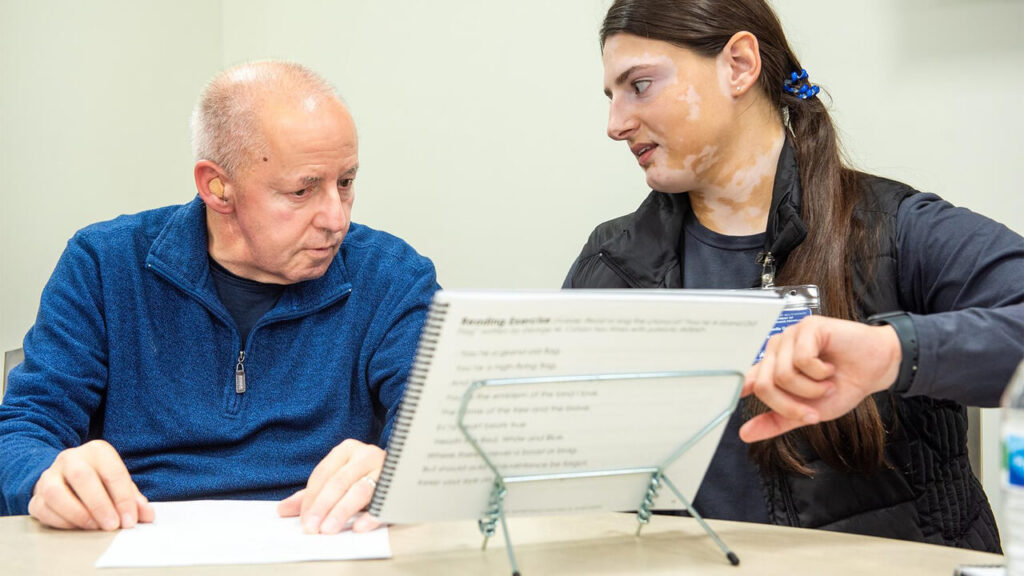
- Provide Therapy: They teach people how to make speech sounds, improve their vocabulary, or strengthen the muscles used for swallowing.
- Counsel and Support: They help patients and their families understand the disorder and learn how to cope with it.

Who They Help and Where They Work
SLPs help people of all ages. Some work with children who have developmental delays, while others help adults who have suffered a stroke or brain injury. They also help people who stutter or have voice disorders.
According to the U.S. Bureau of Labor Statistics, the largest employers of speech-language pathologists are:
- Educational services (schools): 40%
- Offices of physical, occupational and speech therapists, and audiologists: 26%
- Hospitals: 14%
The 6-Step Path to Becoming a Speech-Language Pathologist
Here are the clear steps you need to follow. It takes commitment, but the reward is a stable and impactful career.
Step 1: Earn Your Bachelor’s Degree
Your journey starts with a bachelor’s degree. While a major in Communication Sciences and Disorders (CSD) or a related field is ideal, it is not always required.
If you choose a different major, you will likely need to complete specific prerequisite courses before you can apply to a master’s program. These often include:
- Biological and physical sciences
- Statistics
- Psychology or lifespan development
- Phonetics
- Anatomy of speech and hearing
Step 2: Complete a Master’s Degree in Speech-Language Pathology
This is the most crucial step. You must earn a master’s degree from a program accredited by the Council on Academic Accreditation (CAA). This is non-negotiable for becoming a certified and licensed professional.
Why accreditation matters: Graduating from a CAA-accredited program is required to get the industry-standard certification (the CCC-SLP) and, often, state licensure.
These graduate programs usually take about 2 years of full-time study to complete. During this time, you will complete advanced coursework and your first 400 hours of supervised clinical practicum.
Step 3: Pass the Praxis Examination in Speech-Language Pathology
The next step is to pass the national exam, known as the Praxis. It is a test that assesses your knowledge of the field. ASHA, the governing body for the profession, requires you to pass this exam before you can receive your certification.
Step 4: Complete a Clinical Fellowship
After you graduate, you are not quite finished. You must complete a Clinical Fellowship (CF). This is a post-graduate experience that acts as a bridge between being a student and being an independent professional.
- Duration: The CF requires a minimum of 36 weeks of full-time work (at 35 hours per week), totaling 1,260 hours.
- Supervision: You complete this fellowship under the mentorship of an experienced, certified speech-language pathologist who helps you refine your skills.
Step 5: Obtain State Licensure and Certification
Now, you are ready to officially become a professional SLP! You need to get licensed by the state where you want to work.
While a state license is required to practice, many professionals also pursue the Certificate of Clinical Competence in Speech-Language Pathology (CCC-SLP). The CCC-SLP is the gold standard credential from ASHA. Although not legally required in all states, many employers expect it, and it can open more doors for you.
Step 6: Continue Your Education and Professional Development
The learning never stops. To maintain your state license and your CCC-SLP, you must complete Continuing Education Units (CEU) regularly. This ensures you stay up-to-date with the latest research and best practices.
Additionally, you may choose to specialize in specific areas, such as:
- Child language
- Swallowing disorders
- Autism spectrum disorder
- Fluency (stuttering)
Comparison Table: Education Pathways at a Glance
| Step | Requirement | Details |
|---|---|---|
| 1. Bachelor’s Degree | A 4-year degree (preferably in CSD) | Prepares you for graduate school and often includes prerequisite coursework . |
| 2. Master’s Degree | CAA-Accredited Program (2 years) | Core education with advanced coursework and 400 supervised clinical hours . |
| 3. Praxis Exam | National Exam (Test Code 5331) | Passing score of 162 required to receive CCC-SLP certification . |
| 4. Clinical Fellowship | ~1,260 hours (36 weeks full-time) | Supervised post-graduate mentored experience . |
| 5. Licensure/Certification | State License & Optional CCC-SLP | State license is mandatory. CCC-SLP is the industry benchmark . |
| 6. Continuing Education | Ongoing CEUs | Required to maintain credentials and stay current in the field . |

Career Outlook and Earning Potential
This is where it gets exciting. The job market for speech-language pathologists is incredibly strong.
Job Outlook
Employment is projected to grow 15% from 2024 to 2034, much faster than average. The field is expected to have 13,300 job openings each year over the decade. This growth is driven by an aging population and increased awareness of communication disorders in children.
Salary
The median annual wage for speech-language pathologists was **$95,410** in May 2024 . The highest 10% earned more than $132,850 .
Salary can vary by industry :
- Nursing and residential care facilities: $106,500
- Hospitals: $101,560
- Educational services: $80,280
Important Qualities and Skills for Success
Do you have what it takes? A successful SLP needs a specific set of personal qualities:
- Analytical Skills: To evaluate diagnostic results and create effective treatment plans.
- Communication Skills: To explain complex information to patients and families in a way they can understand.
- Compassion: To support patients who are often frustrated by their communication struggles.
- Critical-Thinking Skills: To make careful assessments and adjust treatment as needed.
- Listening Skills: To truly hear patients’ difficulties and needs.

Speech-Language Pathology: Where to Study
The table below summarizes some highly-regarded programs to get you started.
| University | Location | Approx. Annual Tuition | Key Highlights |
|---|---|---|---|
| University of Washington | USA | Check with university | Top 5 nationally; CAA-accredited. Requires a bachelor’s in CSD or specific prerequisites. |
| Northeastern University | USA | ~$43,785 | Strong interprofessional focus and ties to medical institutions for clinical placements. |
| Yeshiva University | USA | ~$34,980 | Specializes in medical aspects of SLP; offers on-campus and online options. |
| University of New Mexico | USA | Check with university | Average completion time is 2 years; offers a leveling program for students without a CSD bachelor’s. |
| Western Kentucky University | USA | ~$40,000 (Residential) | Offers both on-campus and distance learning formats; affordable options. |
| McMaster University | Canada | CAD ~$79,995 | Innovative problem-based learning curriculum; CAA-accredited. |
| University of Melbourne | Australia | Check with university | #1 university in Australia; graduates eligible for Speech Pathology Australia membership. |
| Newcastle University | UK | Check with university | Practical MSc course approved by the Health and Care Professions Council (HCPC). |
Question-Answer Session
1. How long does it take to become a speech-language pathologist?
It typically takes about 6 to 7 years. This includes 4 years for a bachelor’s degree, 2 years for a master’s degree, and a 9-to-12-month clinical fellowship after graduation .
2. Do I need a doctorate to become an SLP?
No, a master’s degree is the standard entry-level degree required to practice. A doctorate (PhD or SLP-D) is for those interested in research, university teaching, or advanced clinical leadership positions .
3. What is the CCC-SLP and do I need it?
The CCC-SLP is the Certificate of Clinical Competence, a nationally recognized credential from ASHA. While not a legal requirement to practice, many employers prefer it, and it demonstrates that you have met the highest professional standards. A state license is legally required in most states .

Final Words
Becoming a speech-language pathologist is a clear and straightforward journey, but it demands dedication. You must earn a master’s degree, pass a national exam, and complete a clinical fellowship. It is a significant amount of work, but the payoff is a stable, well-paying career with a 15% job growth rate where you literally help people find their voice. If you are passionate about helping others and interested in science and communication, this path is calling your name. Start researching CAA-accredited programs today, and take the first step toward this incredibly rewarding future.
Sources
- Bureau of Labor Statistics, U.S. Department of Labor, Occupational Outlook Handbook, Speech-Language Pathologists
- Maryville University – How to Become a Speech-Language Pathologist
- University of Cincinnati – How to Become a Clinical Speech-Language Pathologist
- Pepperdine University – What Can You Do With a Master of Science in Speech-Language Pathology?
- Missouri State University – Careers and Outcomes
- Science Buddies – Speech-Language Pathologist Career
 Follow us on Google News for latest Scholarships!